
possession flow
Building on the drive summary plot design introduced a few weeks ago and inspired by last week’s look into historic handmade possession diagrams, this week I’m pulling a few elements together into an overall game possession and drive summary visualization:
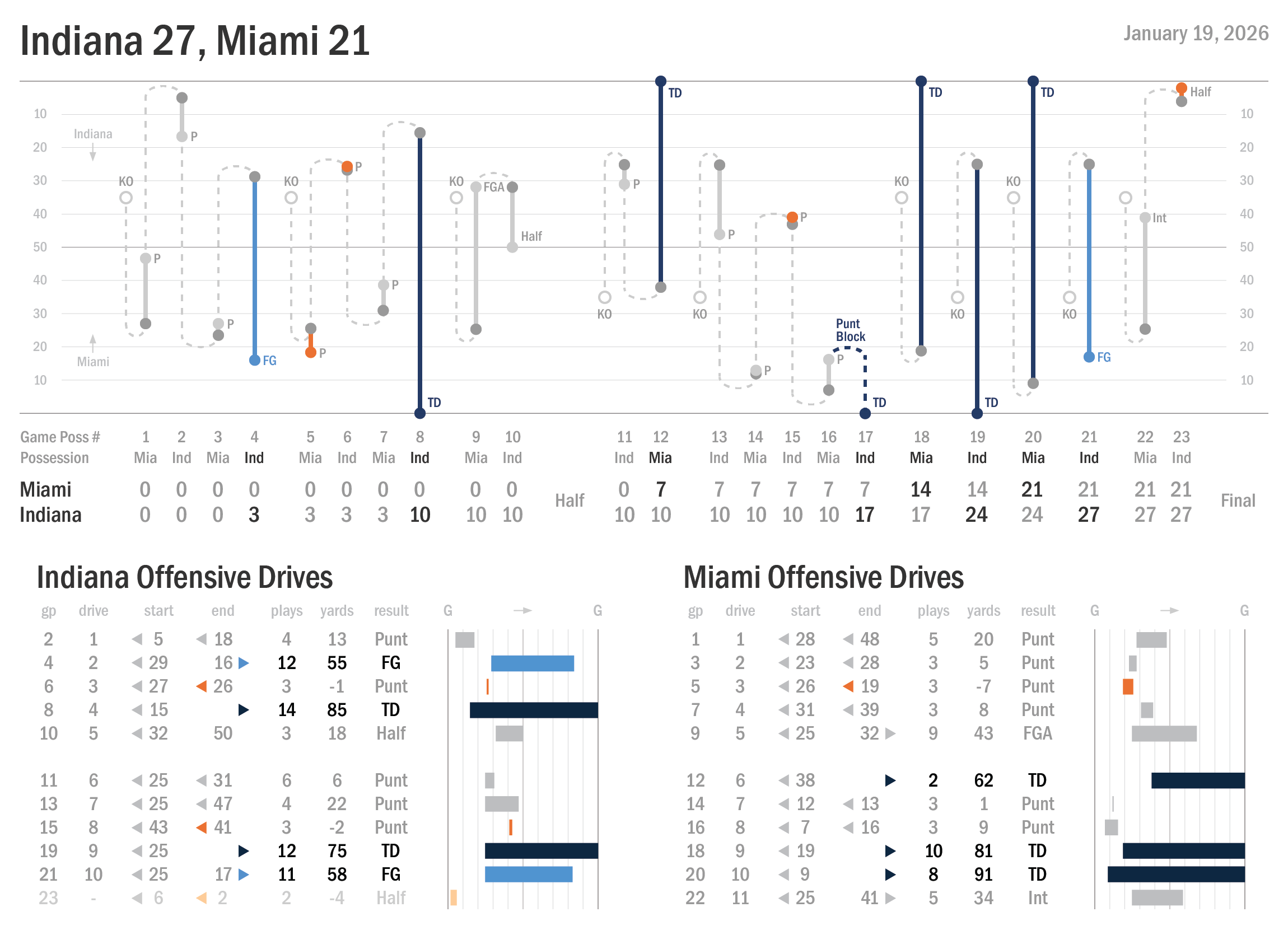
Data visualization of the CFP National Championship game played on January 19, 2026 and won by Indiana over Miami by a final score of 27-21. The visualization elements include a primary chart of the flow of alternating possessions, highlighting scores by each team and key possession change events. Illustrated tables at the bottom of the chart provide more specific information about Indiana and Miami’s respective offensive drive results.
The main idea is to provide all of the basic possession data that I collect from each FBS game and package it into an attractive and replicable chart template that can serve as a quick game summary reference tool that also invites a deeper dive into the details. I would like to think the visualization is working effectively without requiring a companion “how to read and interpret this chart” legend, but perhaps that’s a bit optimistic. Here’s a rundown of what’s here (and what isn’t here) along with some of the design choices I made along the way.
The main graphic element under the header is a chart that illustrates the possession flow of the game. Every possession (as I define them) is included, an alternating sequence that starts with the opening kickoff of each half. I tilted the field 90 degrees from how charts like these are often displayed so that the game sequence proceeds from left to right, with alternating possession of the ball moving up and down along the way.
Possessions are primarily encoded with solid lines that connect dots to denote starting and ending field position on offensive drives. Touchdowns and successful field goal possessions are highlighted and color-coded, as are offensive drives that lose yardage. The colors in the possession flow chart match those in the drive summary charts below it.
Possession exchanges are encoded with dotted lines that represent the “hidden yardage" advantages and disadvantages realized with each special teams or turnover event in the game, and I “looped” the dotted lines to connect one possession to the next for readability. Note that I made the choice not to bother with the specifics of those special events. Whether a kickoff was fielded and returned to the 25-yard line or whether it was kicked through the end zone and resulted in a touchback is irrelevant to me — only the resulting field position is represented in the chart. This is apparent in the punt block touchdown event as well; the bold dotted line doesn’t indicate precisely where the ball was blocked behind the line of scrimmage, recovered, or run in, only that this important non-offensive score event happened.
I resisted crowding the graphic with too much text notation, but there’s a risk that the abbreviations (“P” for punts, “KO” for kickoffs, etc) are indecipherable or unfamiliar. And I’m still thinking about whether some other drive-ending events (turnovers, failed field goals) should receive more visual attention than, say, punts.
I played with several alternatives for indicating the direction of play for each team, and I’m not certain if I’ve successfully made this easy to understand and follow. I also recognize that we don’t witness game play in the same way when we watch the game, so this might aggravate the potential for confusion. Teams flip the direction of play at quarter breaks on the field, but here in the chart they move in the same direction throughout the game. It might take a minute to get your bearings if you’re encountering this format for the first time.
The drive summaries are largely unchanged from the original iteration of these, but I did rearrange some of the elements. Each team’s drive plot progresses from left to right here, which I think makes it easier to compare how the offenses (and the opposing defenses) played over the course of their opportunities. Again, though, there is the a chance that this design choice is disorienting.
Finally, note that Indiana’s last offensive drive (two plays, minus-4 yards on kneel-downs to end the game) is faded out and unnumbered. This is intended to represent that it was a “garbage” possession (again, as I define it). Including the end of game sequence and the punt block touchdown, Indiana had more total game possessions than Miami (12 to 11). But Indiana only had 10 non-garbage drives, one fewer than the Hurricanes.